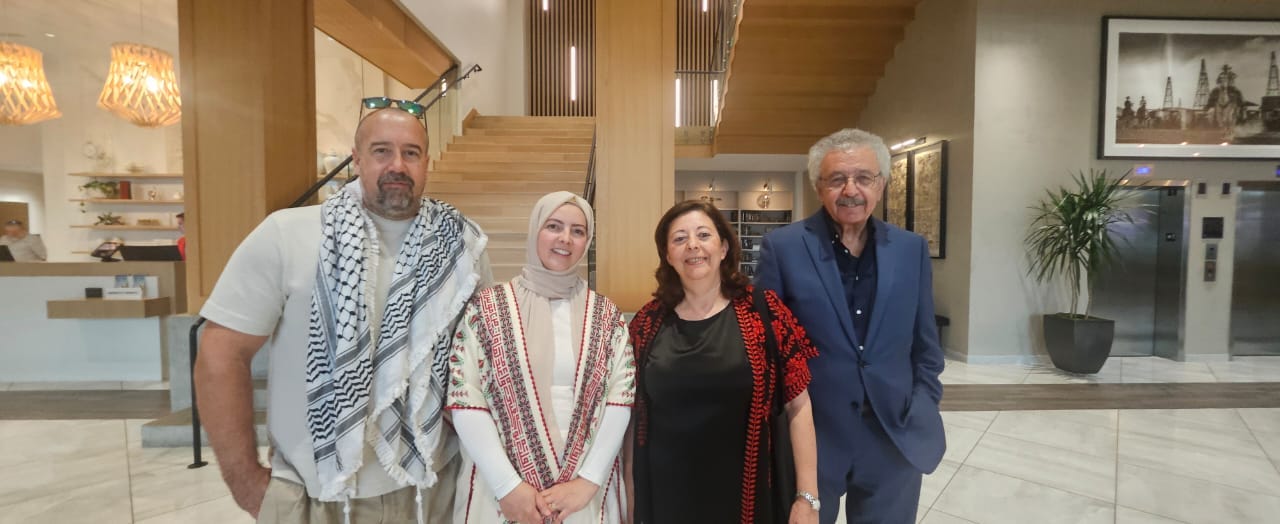
I nominated Ibrahim Nasrallah for the Neustadt Prize. I served on the jury that gave it to him. I still wasn’t ready for what I felt when he took the stage in Oklahoma. It had been a year since his win was announced and our return to OK for the award ceremony.
Palestinian writing is so often introduced through its circumstances. That night it was introduced through its craft via Nasrallah’s work and dedication to it through exile, almost imprisonment and as one of the most under-represented artists in the West. Ask Arab writers and they already know of his work, grew up with it since childhood and know the significance it holds. Nasrallah is a Palestinian poet and novelist, who has spent decades giving language to what the world prefers to summarise, was honoured at the highest level.
The poem that broke the room
The festival was open to the public and students of Oklahoma University and it was wonderful to see their engagement with his work. The students were reduced to tears by his speech.
In it, he said, that ‘in literature we can sit under the shade of the tree that was uprooted, or on the balcony of a house that was demolished & feel the warm hand of a loved one who was killed until we are able to plant that tree, rebuild the house and make certain that the loved one will not be killed again…’
His poem “Mary of Gaza” was another example of how powerful his work is
I have thought about that Nasrallah’s words every day since. Literature refuses the distance between the reader and the loss. It doesn’t ask you to understand Palestine. It gives you a place to sit inside it. That is how a reader’s understanding changes, one person at a time.
The question the young writers asked
Afterwards, a young poet asked whether writing could really make a difference.
His answer has stayed with me longer than the ceremony. If they don’t protect their work, he asked, what else will they not fight for?
He wasn’t promising that a poem or a novel will change the world instantly. He was saying that how we treat our work is how we treat everything we say we care about. Writers who protect the work are the ones who, over time, change what people are able to see.
The banquet
At the celebration dinner, R.C. Davis-Undiano, executive director of World Literature Today, spoke about what lies ahead for Nasrallah’s work, and the Nobel Prize in Literature was mentioned. The Neustadt International Prize is often called the ‘American Nobel’ due to its divergence with the Nobel and I hope we get to see this.
Why I carry this home
I am a British Palestinian novelist. Yassini Girls grew out of my family’s history, and my work is a long argument that our stories belong in the world’s literature, on the same shelf and at the same level.
To be part of this moment, as nominator, juror and witness, is an honour I hold with real humility. A prize doesn’t make a literature. Writers do, and so do the readers who keep reading them. But a prize tells a writer’s people that the door is open, and that the work is already doing something.
To every writer who has wondered whether it matters, and whether to keep going: it does, and you should. Protect the work. Don’t give up hope. We are in this for the journey. One story at a time.

